




Jump
Divisions
Deutsches Elektronen-Synchrotron DESY
A Research Centre of the Helmholtz Association
Desy Global

Suchfunktion
Service functions:
URL: https://www.desy.de/about_desy/lead_scientists/ingrid_maria_gregor/index_eng.html
Breadcrumb Navigation
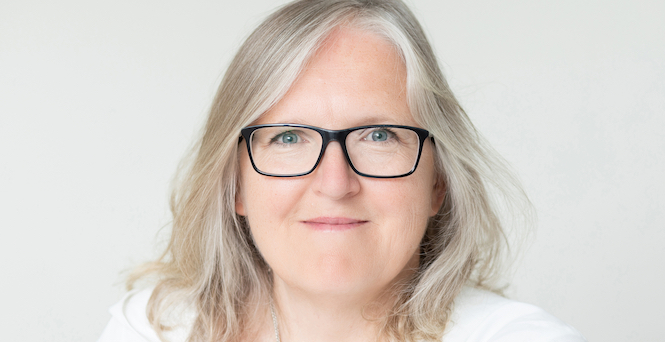
Ingrid-Maria Gregor
ATLAS experiment at the LHC and detector development
Ingrid-Maria Gregor leads the ATLAS group at DESY and is a specialist in detector development, especially silicon tracking detectors. Her group is responsible for producing an endcap of the silicon tracking detector for the upgrade of the ATLAS experiment for the high-luminosity phase of the Large Hadron Collier (LHC) at CERN. She is also Professor for Detector Physics at the University of Bonn.
Throughout her scientific career, Ingrid Gregor has been working in large international particle physics collaborations, such as DELPHI at the LEP collider and ATLAS at the LHC, both based at CERN, as well as HERMES and ZEUS at the HERA collider at DESY. She is an expert in the sensors to detect the particles, the complex detector systems and the reconstruction of particle physics events from the data taken. In all collaborations, she has carried responsibilities in significant parts of detector development, construction and operation.
After doing her PhD at ATLAS, she worked for the HERA experiment HERMES on developing and constructing the recoil detector for the final phase of HERMES operations. After moving to a different part of the HERA ring to the ZEUS experiment, she became the ZEUS calorimeter coordinator. At the same time, she started developing a high-resolution pixel beam telescope, which is used today at test beams at DESY, CERN and SLAC to study newly developed detectors.
After re-joining the ATLAS collaboration, she is now leading the ATLAS group at DESY, one of the largest groups in the international ATLAS collaboration, which is focusing on operation and data analysis. It is also heavily involved in preparing ATLAS for the luminosity upgrade of the LHC.
Additionally, Ingrid Gregor is working on research and development of next-generation silicon tracking detectors for future particle physics tracking detectors. The goal of this work is new pixel detectors that are thinner, faster and have a much better spatial resolution.
Ingrid Gregor is currently Chairperson of the Scientific Committee at DESY, a committee advising the DESY Directorate in strategic questions on research at DESY.
Academic career
|
Since 2022
|
Lead Scientist at DESY and Professor at the University of Bonn |
|
2019-2022
|
Joint appointment DESY and the University of Bonn
|
|
2005-2019
|
Staff Scientist at DESY in Hamburg
|
| 2002-2005 | Postdoctoral Fellow at DESY in Zeuthen |
| 2001-2002 | Postdoctoral Researcher, University of Wuppertal |
| 2001 | PhD, University of Wuppertal |
| 1998-2001 | Research Assistant, University of Wuppertal |
| 1998 | Physics Diploma, University of Wuppertal |
Awards, memberships and roles
| Since 2020 | Chairperson of the Scientific Committee at DESY |
| Since 2015 | Group Leader of the DESY ATLAS Group |
| 2013-2017 | Project Leader of the ATLAS strip detector upgrade |
| 2014 | Scientific Programme Chair of the IEEE Nuclear Science Symposium |
| 2012-2015 | Deputy Group Leader of the DESY ATLAS Group |
| 2006-2013 | DESY II Test Beam Coordinator |
| 2007-2013 | Work Package Leader in the EU-funded projects EUDET and AIDA for the development of a high-resolution pixel telescope |
| 2005-2007 | ZEUS Calorimeter Coordinator |
| 2004-2005 | Technical Coordinator of the HERMES recoil detector |
| 2002 | Award for the best PhD thesis 2001 from the Society of the Friends of the University of Wuppertal |

Footer Navigation
© 2020, Deutsches Elektronen-Synchrotron DESY
