



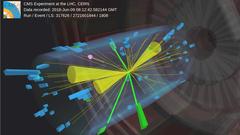
This is what it looks like when a top quark, a W boson and a Z boson occur simultaneously in a particle collision – a very rare event. Photo: CMS Collaboration / CERN
It seems almost impossible that there are still undiscovered discoveries waiting to be made in the sea of data from the LHC particle accelerator at CERN. Over many years, billions of collisions between protons have been recorded there – carefully scrutinised by hundreds of working groups and thousands of scientists around the world. However, DESY scientist Roman Kogler and his doctoral student Alberto Belvedere have just achieved the seemingly impossible: for the very first time, they have detected the joint production of a quark called ‘top’ and two messenger particles called W and Z, as they report in the journal Physical Review Letters. This is interesting not only because it is the first time it has happened, but also because it confirms a long-held assumption and now offers researchers completely new methods for investigating the Higgs field.
To understand why this observation is such a scoop, you need to know that the top quark is one of the heaviest particles in existence. A great deal of energy is therefore required to create it in the proton-proton collisions at the LHC. However, because it is so heavy, the top quark also interacts strongly with the Higgs field, which gives all particles their mass. This is why it is so interesting for particle physics: it gives researchers an opportunity to investigate the Higgs field, which is still largely unexplored and from which the Higgs boson, discovered at the LHC in 2012, originates. The question of what exactly the Higgs field looks like and whether there might be different types of Higgs bosons remains unanswered.
The W and Z particles in the newly discovered process, on the other hand, are particles that transmit one of the fundamental forces of nature: the electroweak interaction. The Higgs mechanism also gives the W and Z particles their mass, but in a completely different way than it does for the top quark. The W and Z particles share their field with the Higgs field, meaning that they consist partly of it. When a single top quark is produced together with a W and a Z boson at the LHC, researchers can investigate the electroweak interaction of the top quark, but also how the Higgs field interacts with these particles.
To understand the significance of this observation, it is also important to know that top quarks, W particles and Z particles, a process known as tWZ production, do not readily appear together. The probability of them being produced together in a collision is seven times smaller than the already very rare production of two top quarks with a Z boson, also called ttZ. This ttZ production is in turn 1000 times rarer than other processes involving two top quarks. The tWZ process is not only very rare, but what makes it even more difficult is that these combinations of particles look extremely similar to ttZ events in the detector. Distinguishing the more frequent, but still rare, ttZ events from the rare tWZ events was therefore a very special feat.
‘'In order to separate them properly, we used the very latest machine learning techniques,’’ explains Roman Kogler. Sophisticated computer algorithms are used to search for patterns that characterise rare events and distinguish them from the many background events. An algorithm that works similarly to modern language programmes and can detect the smallest differences in the data was particularly helpful.
"The fact that we had access to a large data set from collision data from 2016 to 2023 was also helpful.’ According to the scientist, with even more data, the process observed by him and his doctoral student will become clearer and very exciting. They are currently processing the latest LHC data from 2024 and 2025 and will also be involved in data collection next year. When the collider restarts in a few years with an increased collision rate after a planned upgrade break starting in 2026, it will become clear whether everything that can be seen now corresponds to the predictions of the Standard Model of particle physics (the theoretical basis that predicts the properties and interactions of elementary particles) or whether there are deviations.
At the moment, the two researchers are seeing precisely that: a deviation from the prediction. The Standard Model predicts a certain rate for the simultaneous production of top, W and Z particles, but the DESY scientists are observing the particles together more frequently than expected. This could simply be a statistical fluctuation that will even out with higher statistics – or a crack in the Standard Model, which would be another sensation. Kogler does not want to speculate: “We simply have to take a closer look at nature and check, for example, whether we also see this deviation at higher energies. We have only just pushed the door open.”
Beate Heinemann, Chair of the DESY Board of Directors, is delighted with the result: “It's fantastic that we have now also observed this very rare process, because the rarer a process is, the better the chances are that we will discover something fundamentally new. And here we are actually seeing this process more often than expected, so I am very excited to see whether this will be confirmed with more data and, if so, what the reason for this is. My congratulations go to the CMS-DESY group (especially Roman and Alberto) and my thanks go to the LHC accelerator experts at CERN!”
Original publication
A. Hayrapetyan, V. Makarenko, A. Tumasyan, W. Adam, J. W. Andrejkovic, L. Benato, T. Bergauer, M. Dragicevic, C. Giordano et al. (CMS Collaboration), Observation of Production at the CMS Experiment, Phys. Rev. Lett. 136, 081802, DOI: https://doi.org/10.1103/rk6w-1pcl
