



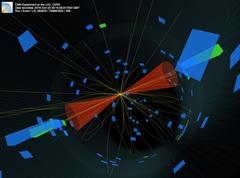
An interactive visualisation of a collision involving two jets, which can be used to determine whether particles consist of quarks: https://cms3d.web.cern.ch/EXO-24-011/ Image: CMS/CERN
Physicists take the view that just because a theory predicts something, that does not mean it is necessarily true. The only way to find out whether a theory is correct is through experiments. Particle physics is based on a theory that has so far described a vast range of properties of particles in extremely precise detail and has withstood every experimental test that particle physicists have thrown at it. On the one hand, researchers are pleased about this – it speaks for the reliability of the theory – but on the other hand, they would very much like to find flaws. Any flaw would open a window onto a new, previously unknown world.
According to the theory, quarks – the particles that make up the nuclear particles such as protons and neutrons – are point-like. This would mean that they cannot be divided any further. Testing this precisely is the mission that DESY scientist Andreas Hinzmann has set himself. Hinzmann conducts research at the CMS experiment, one of the four detectors at the LHC accelerator at CERN, working within a collaboration of 3000 scientists worldwide who developed and operate the experiment. Ever since the LHC began operating in 2009, he and his colleagues – in this case from KIT in Karlsruhe and two institutes in the US – have been checking whether the theory still holds true whenever the collision conditions have been significantly improved. “It’s worth repeating this analysis every few years, particularly when the collision energies are increased,” says Hinzmann.
To test whether the quark, which the theory postulates to be indivisible, really is elementary, the team analyses collisions recorded by the CMS detector. When particles collide, they immediately decay into a cascade of other particles that leave characteristic signatures in the detector. Some of these signatures, known as jets, provide information about the energy of the colliding particles and the directions in which the decay products fly. This is where the analysis by Hinzmann and his colleagues comes in: “If quarks were point-like, as predicted, the resulting particles would have to fly apart with a specific distribution of angles,” Hinzmann explains. “If, however, they had an internal structure, the angular distribution would look completely different.”
The researchers have pushed their study down to a length scale of 10-20 metres – an almost inconceivably small structure, about one hundred thousand times smaller than a proton. Their result: they find no evidence for an internal structure of quarks down to this scale. “This allows us to rule out models in which hypothetical constituents of quarks are bound together by new forces, and it also further constrains scenarios with extra dimensions, quantum black holes or certain models involving dark matter,” explains Hinzmann.
So is this the end of the story, or can we look even deeper? “There is still more to come,” says Hinzmann. “With the data from the latest LHC run and the upcoming High-Luminosity LHC, we can measure the scattering angle with significantly smaller uncertainties, zoom in on even smaller structures and continue the search for the smallest building blocks of matter.”
Their work builds directly on the early days of particle physics, when physicists repeatedly discovered substructure within constituents of matter that had previously been regarded as elementary. Matter consists of molecules, which in turn are made up of atoms. Atoms consist of a dense nucleus surrounded by a cloud of electrons, and the nucleus itself is composed of protons and neutrons, which are made of quarks.
The method used is inspired by a classic experiment by Ernest Rutherford: he fired a beam of helium nuclei at a foil of gold and measured the distribution of scattering angles. By studying their scattering, he was able to infer that atoms had an internal structure and contained a point-like nucleus at their centre. Likewise, in the method applied to CMS collisions, the scattering angles of the particles are expected to reveal whether there are further particles inside the quarks.
CMS Science Briefing: https://cms.cern/news/whats-inside-quarks-cms-looks-deeper
