



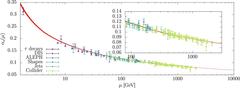
The strength of the strong force is described by the coupling constant αS. The red band shows this value across a wide energy range, as determined in the current publication. The data points show measured values from various experiments, including those from HERA, with the uncertainties specified by the Particle Data Group (PDG). Image: DESY
The glow of stars, the movement of planets, or the interaction of atoms – a set of only four fundamental forces is responsible for all interaction of and in matter. Every earth-based physics experiment which we can carry out in laboratories – small or big – is governed by these four forces: gravitation, the weak force, the electromagnetic force and the strong (often called nuclear) force. In an article in the scientific journal Nature, a team including DESY theorists has now determined the strength of the strong force with unprecedented precision.
At the elementary level the strong force, described by a theory called Quantum Chromodynamics (QCD), acts between quarks and gluons. It binds quarks via gluons inside protons and neutrons which in turn make up the nuclei such as hydrogen, carbon or oxygen. Thus, the strong force specifies how the basic building blocks of nuclear physics are built.
And the name of the strong force is justified: QCD binds quarks and gluons with such a strength that no experiment, not even the most powerful accelerator in the world, the Large Hadron Collider (LHC) at CERN, can knock single quarks out of the protons which are collided there. Instead, particles which are again made of quarks and gluons are found in the detectors at such experiments.
This characteristic property of QCD has been dubbed confinement. By trying to tear away a quark from a bound state, one must inject so much energy into the system that new quark pairs are created as a result. If, on the other hand, the quarks are very closely to each other, they can move almost freely.
This confinement has long been the limiting factor for a detailed understanding of the strong force between quarks and gluons as there is no experiment which can directly measure its strength, described by a number called coupling constant. Still, it acts everywhere and is responsible for the vast majority of phenomena observed in particle physics experiments. So to make most out of the experiments which search for hints of physics beyond the four fundamental forces, it is important to know the coupling constant very accurately.
The theorists in the Zeuthen particle physics group were able to tackle and solve the confinement problem on computers due to three major developments:
1) A mathematically complete formulation of the theory called Lattice QCD.
2) The development of mathematical and numerical strategies to solve the theory.
3) The continuous development of powerful massively parallel computers.
From the very beginning, DESY theory has contributed ground breaking developments to all three fields. In the last two decades a group of current and former DESY theorists has developed more and more powerful numerical strategies which now resulted in a determination of the strong force with record precision as explained in a recent Nature-publication. It finally presents a complete numerical calculation, often called “simulation”, which connects the masses of bound states of quarks and gluons to the strength of the interaction between quarks and gluons. “The numerical strategy bypasses the confinement problem entirely, connecting Gedanken-worlds to the real world, and provides the long-seeked connection of the experimental measurements of the bound state properties to the coupling constant,” says DESY scientist Rainer Sommer, one of the authors of the paper. And further looking back: “While in 1982 theorist Guido Altarelli had to present a detailed argumentation to convince the audience of his presentation at the conference “QCD: 20 years later” that the QCD coupling can be determined with an uncertainty below 10%, with the help of Lattice QCD and a DESY-theory-devised strategy the recent publication broke the 1% threshold of accuracy in describing the coupling constant of the strong force significantly.”
Reference
Dalla Brida, M., Höllwieser, R., Knechtli, F. et al. High-precision calculation of the quark–gluon coupling from lattice QCD. Nature 652, 328–334 (2026). DOI: 10.1038/s41586-026-10339-4
Further reading
K. G. Wilson, Confinement of quarks, Phys. Rev. D 10, 2445 (1974). DOI: 10.1103/PhysRevD.10.2445
Altarelli, G. QCD and experiment: status of αs. In Proc. Workshop on QCD : 20 years later (CERN-TH-6623-92) 172–204 (CERN, 1992)
Lüscher, M., Weisz, P. & Wolff, U. A numerical method to compute the running coupling in asymptotically free theories. Nucl. Phys. B 359, 221–243 (1991), DOI: 10.1016/0550-3213(91)90298-C
Dalla Brida, M. et al. Non-perturbative renormalization by decoupling. Phys. Lett. B 807, 135571 (2020), DOI: 10.1016/j.physletb.2020.135571
