


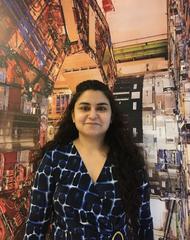
During her time at DESY, scientist Saptaparna Bhattacharya took a very close look at events involving three bosons. Photo: DESY, Katerina Lipka
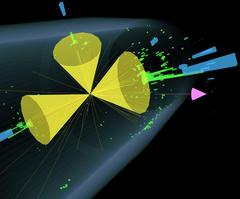
A new analysis by scientists working on the CMS experiment at CERN’s particle accelerator Large Hadron Collider studies exceptionally rare events in particle collisions that produce three massive force-carrying particles at once. By examining these unusual events, researchers searched for signs of unknown phenomena – and set some of the strongest constraints to date on where one might find them.
The Standard Model of particle physics, the theory that describes all known particles our world is made of and the forces that act between them, has successfully predicted an enormous range of phenomena with remarkable precision. So far, every experimental test has confirmed the Standard Model’s predictions. Physicists welcome this success but are eager to detect deviations indicative of effects beyond our current understanding.
One of the rarest processes predicted by the Standard Model occurs when a single proton-proton collision produces three massive force-carrier particles, or “bosons”, at the same time: W and Z bosons, the carriers of the weak nuclear force. These so-called “triboson” events were first observed by the CMS collaboration in 2020 and remain among the most challenging collision result to study at the Large Hadron Collider at CERN. In a new analysis, CMS performed the first comprehensive search for physics beyond the Standard Model using triboson events in which all three bosons carry particularly high energies, known as “boosted” bosons.
The work was led by Saptaparna Bhattacharya (now assistant professor at Southern Methodist University in the US) during her time as an Alexander-von-Humboldt Research Fellow at DESY. This fellowship, funded by the Humboldt Henriette-Herz Scouting Program, was part of the larger DESY project “Standard Model at Ultimate Precision (STANDUP), led by Henriette-Herz Scout Katerina Lipka (DESY scientist and professor at the universities of Wuppertal and Lund). Supported by the Helmholtz Initiative and Networking Fund, STANDUP aims to indirectly search for new effects by looking for tiny deviations from expectations in high-precision measurements of Standard Model parameters (for example particle masses and interaction strengths). STANDUP has made leading contributions to high-precision or measurements CMS measurements, most recently the observation of the tWZ process.The fellowship awarded to Saptaparna Bhattacharya provided the time, resources and scientific environment within the DESY CMS group needed to deliver an analysis of this scale.
The study combines ten different experimental scenarios and tests 32 potential new-physics interactions within a single statistical framework. To extract as much information as possible from these rare triboson processes, the researchers divided the analysis into ten different categories with different numbers of electrons, muons or tau and highly energetic particle jets observed in the detector.
That is because each of the three bosons can decay either into quarks, producing jets of particles, or into leptons. Different decays look different in the detector. The researchers paid particular attention to the total energy of the collision: new heavy particles or interactions would most likely appear as small excesses in the highest-energy regions of the data.
“By mapping these complex events, we aim to uncover hints of new physics through the subtle signatures of heavy, undiscovered phenomena,” summarises Bhattacharya.
For the most challenging signals, the researchers additionally used a machine-learning method to better distinguish potential signals from the much larger background of Standard Model processes.
“To uncover hints of new physics at the extreme edges of the Standard Model, we had to build an intricate analysis,” says Bhattacharya. The team set new constraints on 32 different new-physics scenarios and thus significantly extended the reach of previous triboson studies. The result: the data agree with the predictions of the Standard Model, probing the theory in one of its most extreme experimentally accessible regimes.
The ongoing Run 3 of the LHC will provide even more data at higher collision energies, allowing triboson measurements to evolve from rare observations into precision tools for exploring physics beyond the Standard Model.
Original publication
CMS Collaboration, Search for new physics in triple boson production in proton-proton collisions at s√ = 13 TeV using the effective field theory approach
