



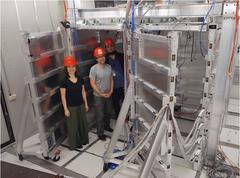
The CODEX-beta detector. Left to right: Juliette Alimena (DESY), Philip Ilten (University of Cincinnati), Carlos Vazquez Sierra (University of A Coruña). Credit: Titus Mombächer (University of A Coruña)
Could it be that at least some of the novel particles that Large Hadron Collider collisions make are outside of its famously massive detectors? A prototype detector called CODEX-beta will try to find out – and it has now recorded its first data at CERN. The collaboration around CODEX-beta – and its proposed larger version, CODEX-b – includes several institutes from around the world and a DESY scientist is its deputy spokesperson. CODEX-b is designed to test a different way of searching for hidden particles: looking for signs of new physics that could travel some distance from an LHC collision before decaying in a quiet, shielded space nearby.
The main experiments at the Large Hadron Collider (LHC) at CERN are among the best tools scientists have for exploring why our universe is the way it is. Between CMS, ATLAS, LHCb, and ALICE, massive amounts of data from these four experiments have given many important details to scientists. But nothing among that data has yet confirmed a break with the current theory of particle physics, the Standard Model. The Standard Model has been very resilient, describing the known elementary particles with remarkable precision, and so far, LHC data matches the predictions and calculations inferred by the model. However, it is incomplete, as it still leaves major questions unanswered, among which are: What is dark matter? Why is there more matter than antimatter in the universe? Why does the Higgs boson have the properties it does?
Hidden particles could be a part of the answer. At the same time, the LHC’s main experiments are not optimized for every possible kind of signal. CODEX-b is built on the idea that new particles might already be produced in LHC collisions, but that they are difficult to spot near the busy collision point. Some could travel several metres before turning back into ordinary matter, leaving traces in places where dedicated detectors like CODEX-b can be designed to look.
CODEX-b is intended to find something known as long-lived particles. Most particles produced in LHC collisions turn into other particles in vanishingly short amounts of time in a process called particle decay. Decay products are often the signals that point to new particles. Decays have been thought to happen within the space of the massive LHC detectors, but if the decays happen later – if the particles were longer-lived – they might decay outside of the scope of the detector. CODEX-b would have a chance of picking them up. Those events could carry information about new physics important to our understanding of the universe.
CODEX-beta, which began taking data in May 2026, measures about two metres on each side, roughly a fifth the size of the proposed CODEX-b detector. Its purpose is to test the detector concept in real LHC conditions and to provide measurements needed for the design of the full experiment. The aim is to create a search region with as little background as possible.
“Designing and building this prototype was a tremendous effort by a small group of dedicated high-energy physics experimentalists, theorists, and engineers, many of whom donated their spare time to the effort,” says Philip Ilten, a professor at the University of Cincinnati in the US and spokesperson for the experiment. “The data from this prototype will be essential to realizing this type of detector concept, showing that we really can search for new physics this way.”
“CODEX-beta is an important step because it lets us study the detector concept in real LHC conditions,” says Juliette Alimena, a DESY scientist, researcher in the University of Hamburg Cluster of Excellence Quantum Universe, and deputy spokesperson for the experiment. “If we want to search for rare particle decays in a deliberately quiet environment, we first need to understand that environment extremely well. These first data are the beginning of that process.”
First proposed in 2017, CODEX-b has grown into an international collaboration of around 60 members at about 20 institutions. If approved by CERN, the full detector would be located next to the LHCb detector.
Further information:
Read the article from the Lawrence Berkeley National Laboratory in the USA: https://physicalsciences.lbl.gov/2026/07/08/codex-beta-records-first-data-in-search-for-hidden-particles/
