



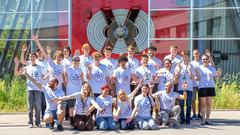
Students from the UK and the US came to DESY this year as part of the ‘Beamline for Schools’ competition. Image: DESY, Marta Mayer
When 19 high-school students are glued to a control room for days on end – except perhaps for a game of snooker or a spot of power sightseeing – it must be ‘Beamline for Schools’. Launched 13 years ago by CERN, this science competition for students has also taken place at DESY since 2019. Even after all these years, there are no signs of it losing momentum; on the contrary: almost every year, new application records are broken, and every year there are new, ingenious ideas for experiments on real beamlines at what are now three different research centres.
How does BL4S work?
But let’s start at the beginning: how does Beamline for Schools (BL4S) work? High school students must form teams and design an experiment that could be carried out on a beamline. Beamlines are ‘branches’ of existing particle accelerators, through which the accelerated particles can be steered at all sorts of things: small experiments, detector components, prototypes, samples and materials. DESY has such beamlines at several accelerators; the BL4S experiments take place at the DESY II accelerator, which, incidentally, gave the research centre its name. They're typically used to test components for future particle detectors.
Once a team has designed an experiment (they’re, of course, allowed to ask their teachers and other experts for help; every country has its own BL4S contact person), they must submit a brief description outlining the setup, research question and objectives, along with a one-minute video (which should be as original as possible) as part of their application. Real researchers, engineers and technicians assess the applications and select the most exciting and original ones.
The teams are then invited to carry out these experiments simultaneously either at CERN in Geneva, at DESY, or – for the past two years – at the ELSA accelerator at the University of Bonn. The travel costs, two weeks’ accommodation and meals, training sessions, tours and the leisure programme are funded by the CERN & Society Foundation, a charity dedicated in particular to socially relevant projects and the promotion of young scientists.
Since the first edition of BL4S in 2014, 28,800 school pupils from around 100 countries have applied. This year, a team from Liverpool in the UK and a team from Lafayette in the US state of Colorado were guests in Hamburg, whilst a team from Bangladesh travelled to Bonn and one team each from India and Turkey travelled to Geneva.
Science with a smartphone
Their projects could not be more diverse, ranging from fundamental research into Cherenkov radiation to potential new materials for particle detectors and neutrino physics. The ‘Mobile MIPS’ team from Liverpool, for example, brought along a bunch of ten-year-old mobile phones, wired them in series and investigated whether the cameras’ CMOS sensors could detect the particle beams passing through them. The idea behind this is: could such mobile devices be used to detect particles from space? This would transform an everyday object available practically everywhere into a combined experimental device that could be used at any time, for example in physics lessons.
“The CMOS sensors in the phones detect the energy emitted by the particles as they fly past. If you connect several of them in series, you can reconstruct the particle’s path from the individual data points,” explains Amina Magdy, a member of the “Mobile MIPS” team at the University of Liverpool’s School of Mathematics. However, there are a number of challenges: the phones must be precisely aligned (so the team has developed special mounting brackets); the signals must be free from noise (so the team has designed a cooling system to keep the phones at a constant 19 degrees); and the phones must also be precisely synchronised (so the team has developed an app that synchronises the phones precisely).
A genuine research experience
The team was able to present their initial data, including a fully reconstructed particle track, at the traditional VIP Day, which was also attended by representatives from the embassies and consulates of the teams’ home countries. “The cool thing about Beamline for Schools is how close it is to real science,” said DESY Director Beate Heinmann at the event. “You conduct experiments at school too, of course, but the results are predetermined. With Beamline for Schools, you’re conducting experiments to discover things we don’t yet know. That’s exactly what science is all about! What’s more, we work together in teams, just like you do. And sometimes things don’t work out – that’s completely normal too.” “Science requires curiosity and creativity, and the courage to ask new questions,” added Annette Scheersoi, Vice-Rector for Sustainability at the University of Bonn. “We are very happy and proud to welcome a BL4S team to our electron stretcher facility, ELSA, once again this year."
Experts at 16
Merlina Rojas, aged 16, from the Centauri Stars team in the USA, says she has always wanted to know everything about physics. “I can’t believe I’m here. I’m sure I’ll learn more about science and how it works in these two weeks than I have in my whole life so far,” she says at the start of her stay. However, she already has a great deal of knowledge up her sleeve to bring to DESY: “Strictly speaking, nothing is faster than light. Under certain conditions, however, charged particles can be faster – specifically, when they fly through something. This produces the bluish glow that we recognise from nuclear power stations,” she explains. “We want to find out whether this radiation can also be measured using a specific type of particle detector. For now, this is an experiment designed to improve our understanding of Cherenkov radiation, but perhaps other applications for it can be found at some point.”
“You mustn’t underestimate how much the kids learn just through the preparation,” says Kimberley Becker, the US team’s teacher. “The Centauri Stars came up with the idea of studying Cherenkov radiation in more detail. They then contacted a Cherenkov expert and, over several Zoom meetings, worked out the best experimental setup with him.” Now the team are experts in the field themselves. Their experimental setup: the particle beam passes through a 50 cm-long quartz rod housed in an aluminium tube within a light-tight chamber; the resulting internally reflected Cherenkov photons are detected and read out by an array of particle detector chips known as SiPMs. And their results? It works! SiPMs can detect the radiation when the particle beam travels parallel to the quartz rod.
Next year, Beamline for Schools will enter its next round. As all the accelerators at CERN will be shut down for several years, Beamline for Schools is expected to take place at DESY and the University of Bonn.
Further reading
More about Beamline for Schols and about this year's edition:
https://beamlineforschools.cern
Welcome video
Press release
